Why the comparison matters
Chain link fence has been the default boundary solution for decades — cheap, fast, widely available. 358 welded mesh has taken over in any application where security is the primary brief, not just demarcation.
The problem is that both products look like "just a fence" to anyone who hasn't specified one under real pressure. This guide makes the differences concrete: aperture size, cut resistance, climb difficulty, visible deterrence, cost per metre and typical project fit.
Procurement managers, quantity surveyors, security consultants and importers specifying fence for projects where "it looked like a fence" is not a sufficient answer if something goes wrong at the site.
What each product actually is
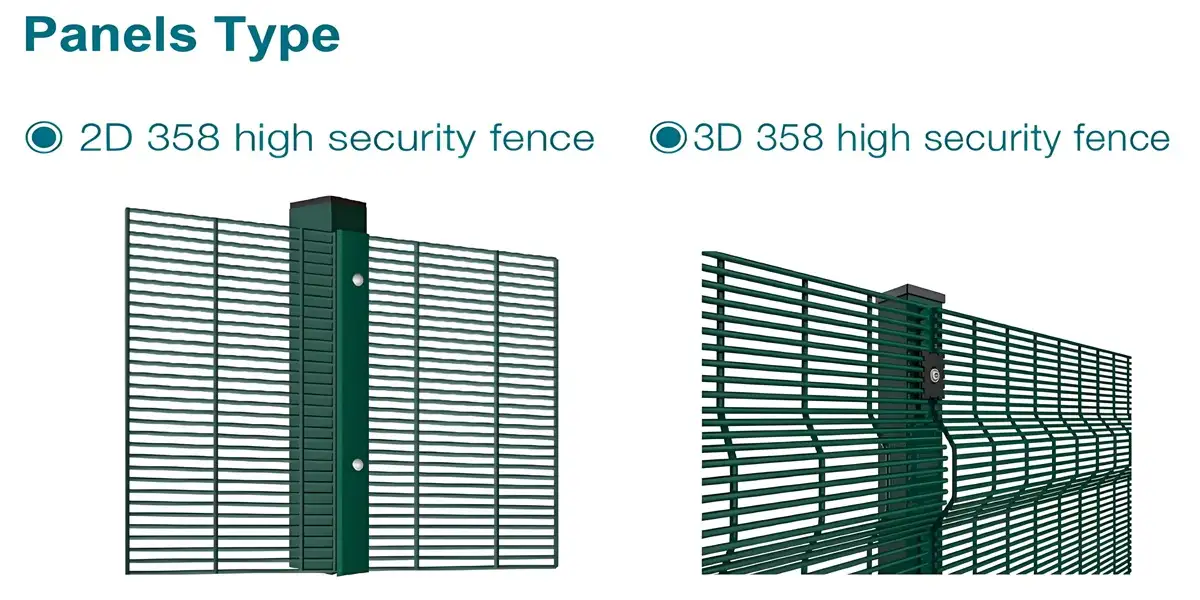
358 Anti-Climb Fence
The name comes from its defining dimension: 3 inches × 0.5 inches (76.2 mm × 12.7 mm) mesh aperture. That opening is small enough that fingers cannot get a grip and bolt cutters cannot get purchase without an unusually large jaw opening.
It is a welded wire mesh panel — horizontal and vertical wires resistance-welded at every intersection, forming a rigid flat panel typically 2.0 m – 2.4 m high. Wire diameter is usually 4 mm for standard security grades, up to 6 mm for high-security IWS variants.
Chain Link Fence
Chain link is a woven wire fabric — a single wire formed into a continuous zig-zag spiral and interlocked to form a diamond-pattern mesh. Standard aperture is 50 mm × 50 mm diamond. Wire diameter ranges from 2.0 mm (light residential) to 3.55 mm (heavy commercial).
Head-to-head specification comparison
Standard commercial-grade products — 358 mesh at 4 mm wire against chain link at 2.5 mm wire, both 2.0 m high, hot-dip galvanised finish.
| Specification | 358 Anti-Climb (4 mm) | Chain Link (2.5 mm) | Advantage |
|---|---|---|---|
| Mesh aperture | 76.2 × 12.7 mm | 50 × 50 mm diamond | 358 — fingers can't grip |
| Wire diameter | 4.0 mm (up to 6 mm) | 2.0 – 3.55 mm | 358 — heavier gauge standard |
| Climb difficulty | Very high — no foothold | Low — diamond is a ladder | 358 — by design |
| Cut resistance | High — requires heavy-jaw cutters | Low — standard wire cutters | 358 — significantly harder |
| Panel rigidity | Rigid welded panel | Flexible woven fabric | 358 — harder to push through |
| Visibility through | Good — aperture limits CCTV | Excellent — open diamond | Chain link — depends on spec |
| Supply cost (FOB) | USD 18 – 28 / m² | USD 4 – 10 / m² | Chain link — much cheaper |
| Installation speed | Slower — rigid panels | Faster — roll and tension | Chain link — faster on site |
| Corrosion resistance | Excellent — EN 10244 | Good — thinner zinc per wire | 358 — heavier zinc bath |
| PIDS compatibility | Yes — purpose-built | Limited | 358 — designed for IDS |
The price gap looks large in the table — but installed cost is closer than supply cost suggests. 358 panels require fewer posts (stronger panels span further), no tensioning hardware, and faster defect detection. For a 500-metre perimeter, the installed gap narrows to 25 – 35% once labour is included.
The security case for 358
Three things make 358 mesh genuinely harder to breach than chain link — and they compound each other:
- No climbable aperture. The 12.7 mm horizontal gap cannot accommodate a finger grip. Climbing requires gripping the top rail or using an external tool — both visible on CCTV.
- Heavy wire resists cutting tools. Standard 4 mm wire requires bolt cutters with a jaw opening above 18 mm. A 6 mm IWS variant requires industrial-grade equipment — the time and noise required is prohibitive for an opportunistic intruder.
- Rigidity prevents the "push-through" attack. Chain link flexes significantly under lateral pressure. Welded mesh doesn't flex in the same way.
CPNI (Centre for the Protection of National Infrastructure) recommends 358 or equivalent welded mesh for critical national infrastructure perimeters. Most airport perimeter specifications globally now reference 358 or IWS as the baseline.
When chain link is still the right choice
- Sports facilities and ball courts — maximum visibility required, impact resistance (not cut/climb) is the spec.
- Agricultural boundaries — chain link's flexibility makes it far easier to install on undulating ground over long distances.
- Temporary demarcation — chain link coils back onto a reel; 358 panels do not.
- High-volume, low-threat commercial perimeters (car parks, retail back yards) where the brief is deterrence rather than prevention, and budget is constrained.
Ask: "If this fence is breached, what is the cost?" Property damage or theft → chain link may be sufficient with good lighting. Personal injury, regulatory breach or critical infrastructure compromise → specify 358.
Specification checklist before you order
For 358 Anti-Climb Mesh
- Wire diameter: 4 mm standard / 5–6 mm high security
- Panel height: 2.0 m, 2.4 m, 3.0 m — match post height to panel
- Panel width: 2.5 m or 3.0 m — confirm post centres before ordering
- Finish: HDG ≥ 80 g/m² + PVC coat for coastal environments
- Top: flat, cranked arm (barbed wire) or anti-climb spike rail
- PIDS: confirm sensor bracket compatibility before post selection
For Chain Link
- Wire gauge: 2.0 mm (light) / 2.5 mm (commercial) / 3.55 mm (heavy)
- Aperture: 50 mm standard — 60 mm or 75 mm for agricultural
- Finish: electro-galvanised (indoor) or HDG (external)
- Selvedge: knuckle/knuckle (sports) or knuckle/twist (sharper top)
- Line post centres: 3.0 m max for commercial, 2.5 m for exposed sites
The short answer
If the perimeter needs to stop a determined person — specify 358. The cost premium is real but not as large as raw supply prices suggest, and the gap in performance is significant.
If the requirement is boundary demarcation, visibility, cost control at scale, or installation on difficult terrain — chain link does the job and does it cheaply.
The question to ask is not "which is cheaper?" but "what does a breach actually cost us?"
Tell us the height, run length, finish and destination. Factory-direct price within 24 hours.